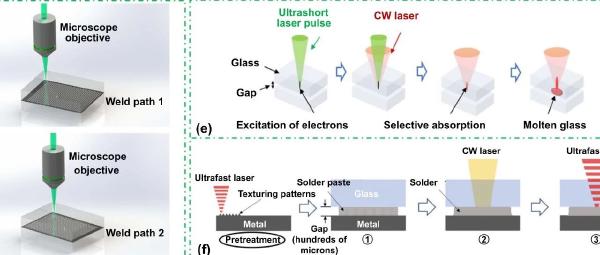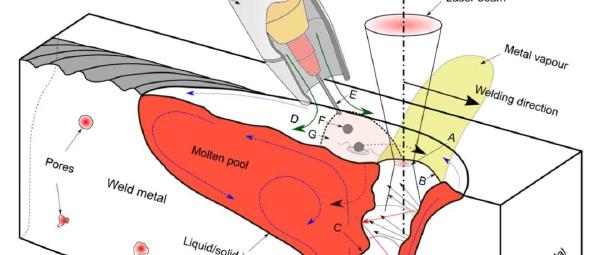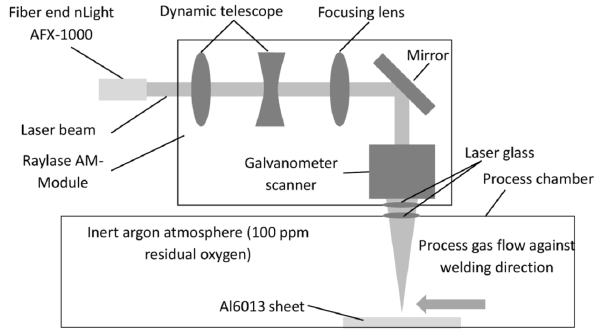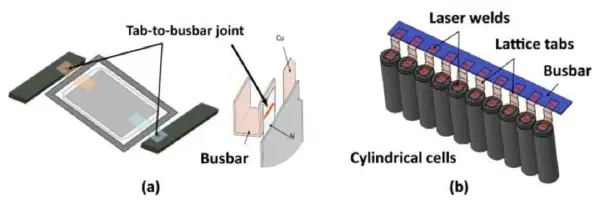
Battery tab-to-busbar welding must deliver more than mechanical attachment. A production joint has to combine adequate strength with low electrical resistance, limited temperature rise, and controlled intermetallic formation—especially when aluminum and copper are joined. A dual-beam laser separates penetration from thermal-field control by combining an intense core with a broader ring.
EV batteries Tab-to-busbar joints Core-ring laser Al–Cu dissimilar joining
Concentrates energy, opens the weld, and primarily controls penetration.
Preheats and postheats, smooths the thermal field, and stabilizes the melt pool.
Balances strength, resistance, temperature rise, and intermetallic compounds.
Application background
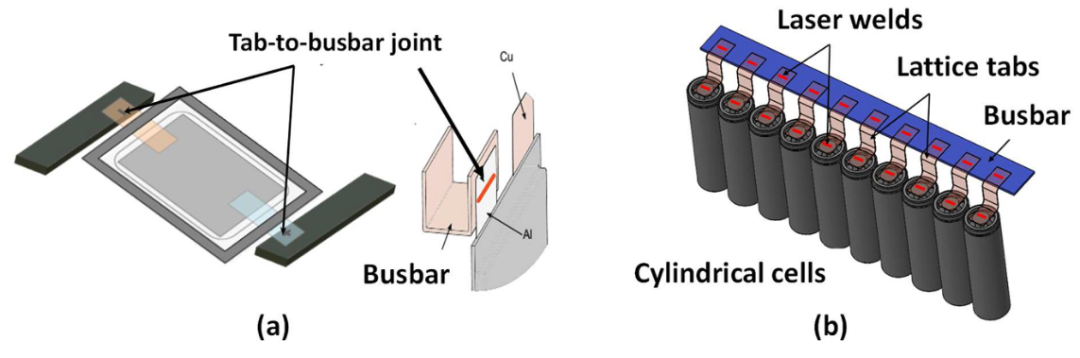
Battery performance and safety depend strongly on the joint between a cell tab and a module busbar. It must carry current reliably while surviving vibration, thermal cycling, and long service.
Ultrasonic and resistance welding are mature for many similar-material combinations. Al–Cu joining is harder because aluminum and copper differ strongly in melting point, thermal conductivity, and thermal expansion. Fusion can generate brittle intermetallic compounds (IMCs), pores, cracks, and spatter. A single-mode laser is fast and concentrated but may intensify the same problems through excessive local heat.
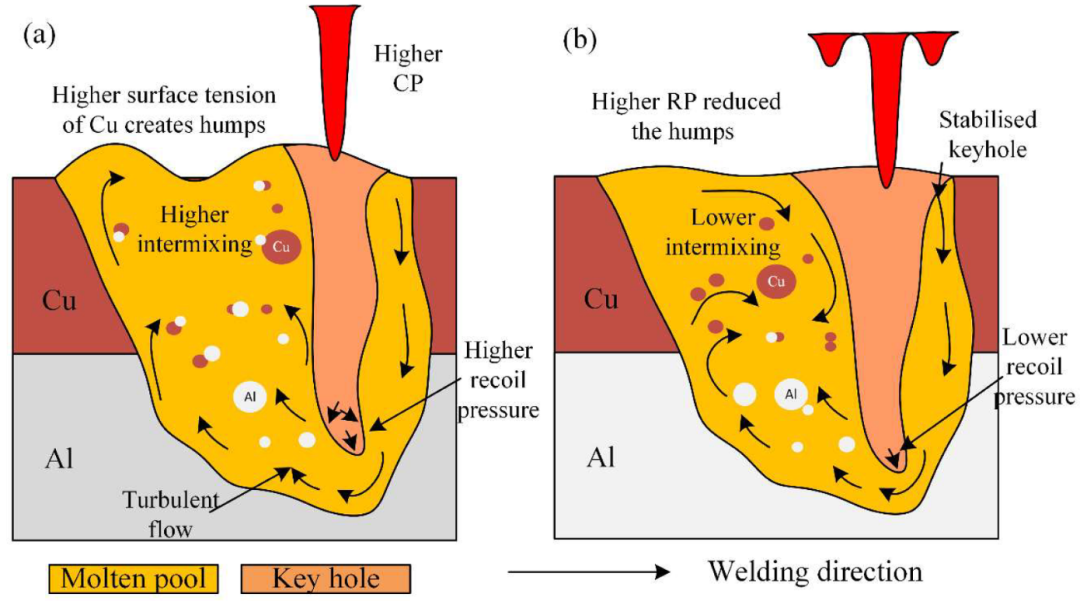
A core-ring dual-beam laser independently controls the central and annular powers. The core establishes penetration; the ring modifies pool circulation and temperature gradient. This can reduce defects and IMC growth while improving mechanical and electrical performance.
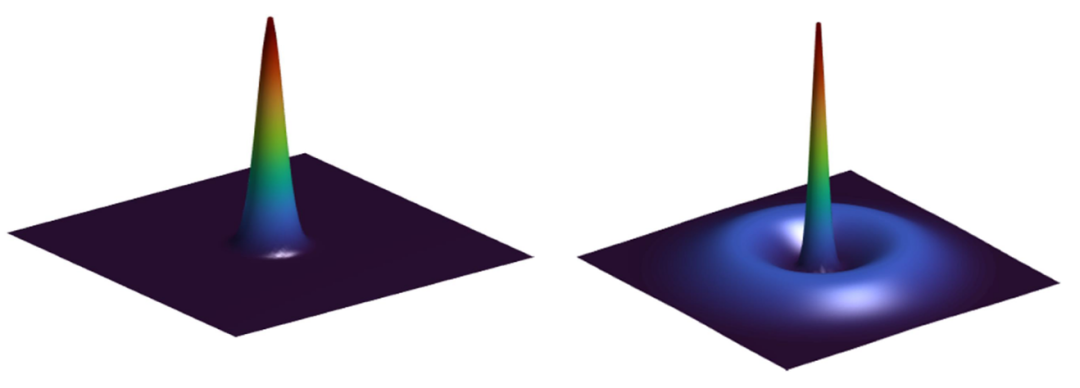
Core-ring beam concept
The optical field contains two independently powered regions:
- a core approximately 58 µm in diameter, with high intensity for deep narrow penetration;
- a ring approximately 413 µm in diameter, with distributed energy for preheating, postheating, pool stabilization, and stress reduction.
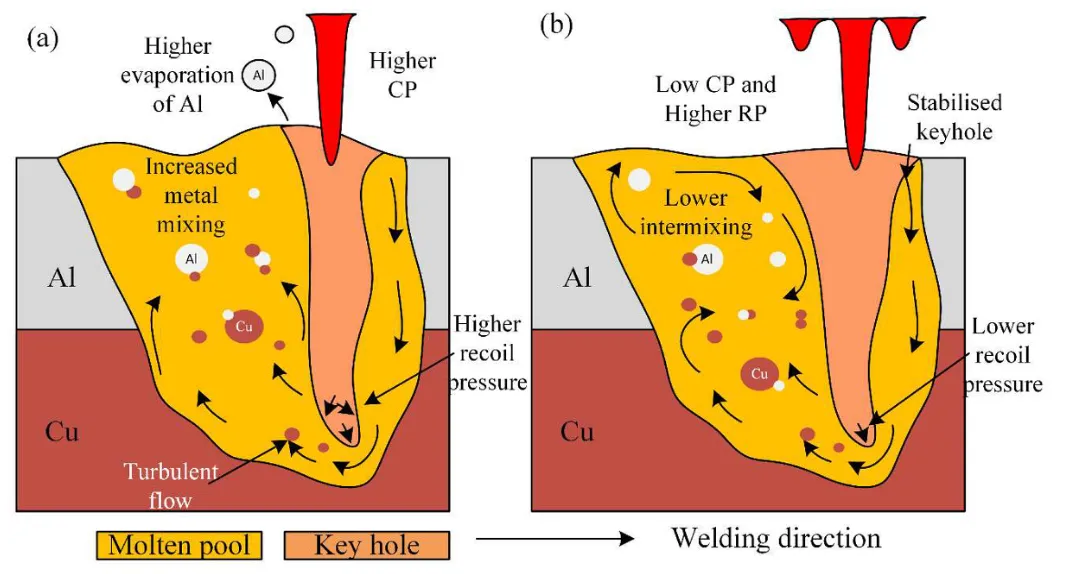
Cu–Cu welding benefits from higher core power because copper removes heat rapidly, while ring energy helps prevent collapse and sharp gradients. Al–Cu requires a lower central peak because aluminum melts and vaporizes more readily; ring power can then broaden and stabilize the thermal field.
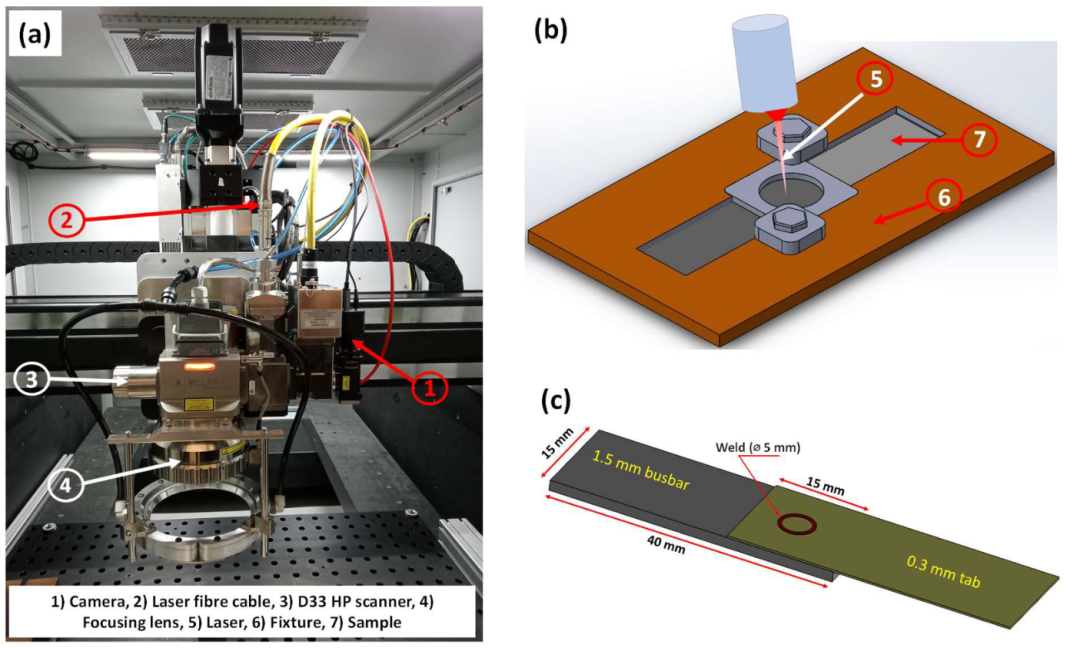
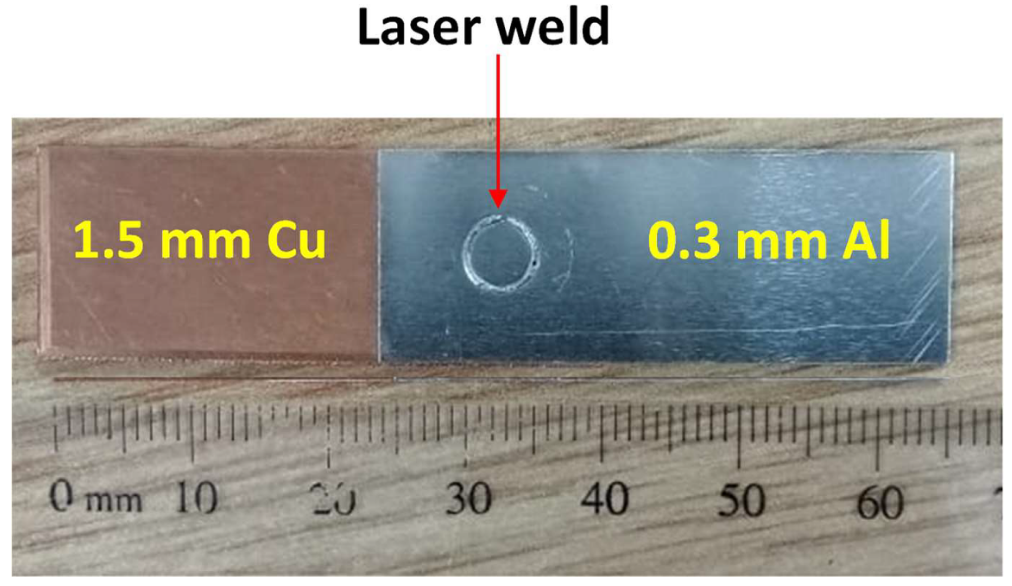
Process variables
Core power, ring power, and travel speed jointly determine heat input, penetration, pool stability, and the extent to which dissimilar materials mix. Their effects cannot be judged independently, and reversing the stacking order from Al–Cu to Cu–Al changes the usable window.
Core power
Core power controls the main energy input and weld depth.
Similar materials
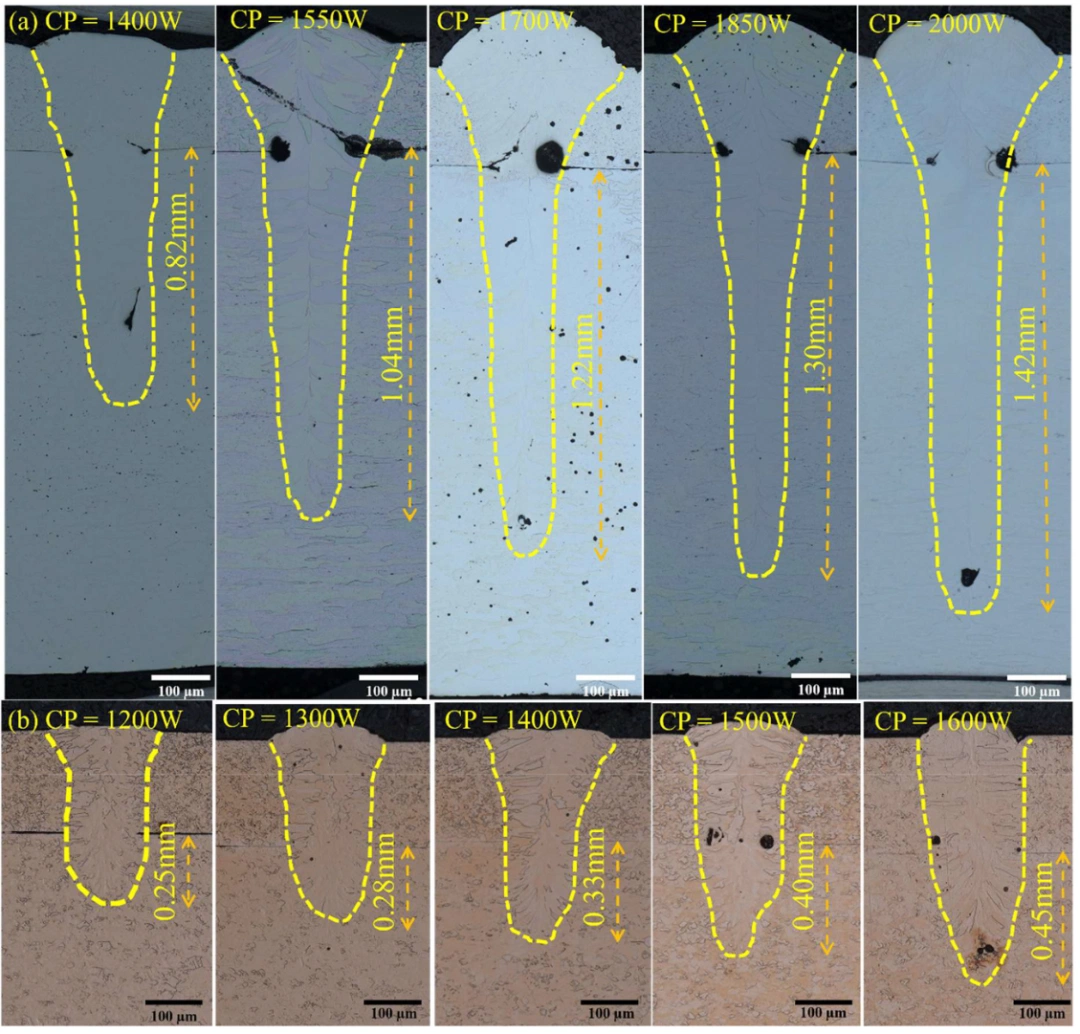
- Al–Al: raising core power from 1400 to 1850 W increases depth and joint strength to 221.2 N. At 2000 W, cracks and a root void appear and strength falls to 176.2 N. Aluminum’s low melting point and high expansion make excessive local heat damaging.
- Cu–Cu: within the studied range, higher core power creates a larger bonded area and strength reaches 613.2 N. Copper’s high thermal conductivity demands and tolerates more concentrated energy.
Dissimilar materials
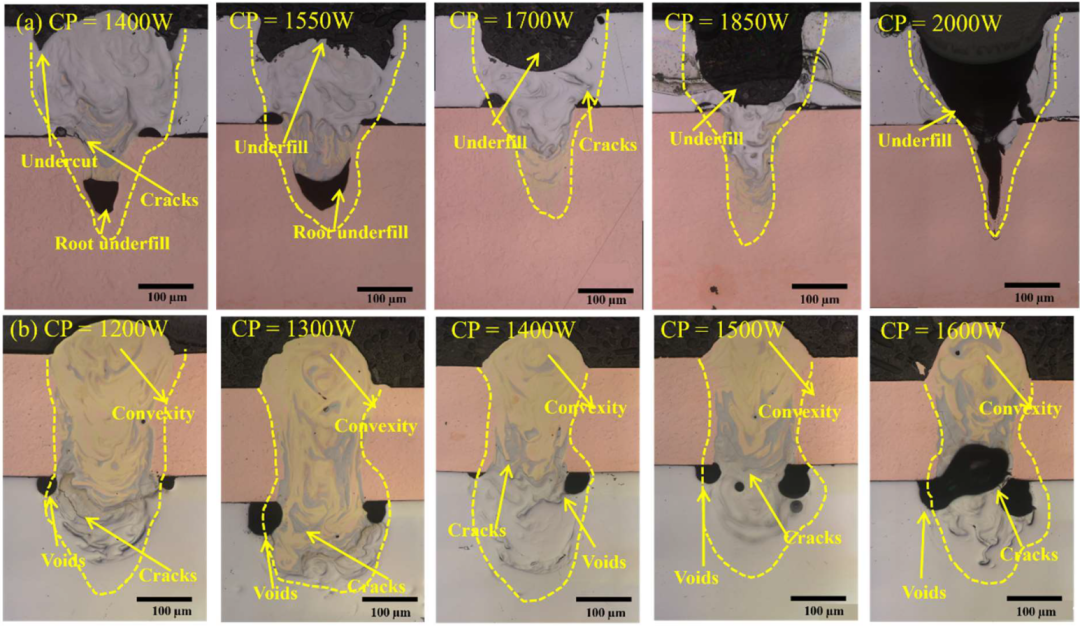
- Al–Cu: increasing core power from 1400 to 2000 W does not significantly deepen the weld but causes depression; strength falls from 475.6 to 422.8 N because the aluminum side overheats and evaporates.
- Cu–Al: at 1400 W, voids are limited and strength reaches 508.6 N. Higher power increases reinforcement and upward transport of molten aluminum, intensifying IMC and crack risk.
Ring power
Ring power primarily stabilizes and shapes the pool rather than directly determining penetration.
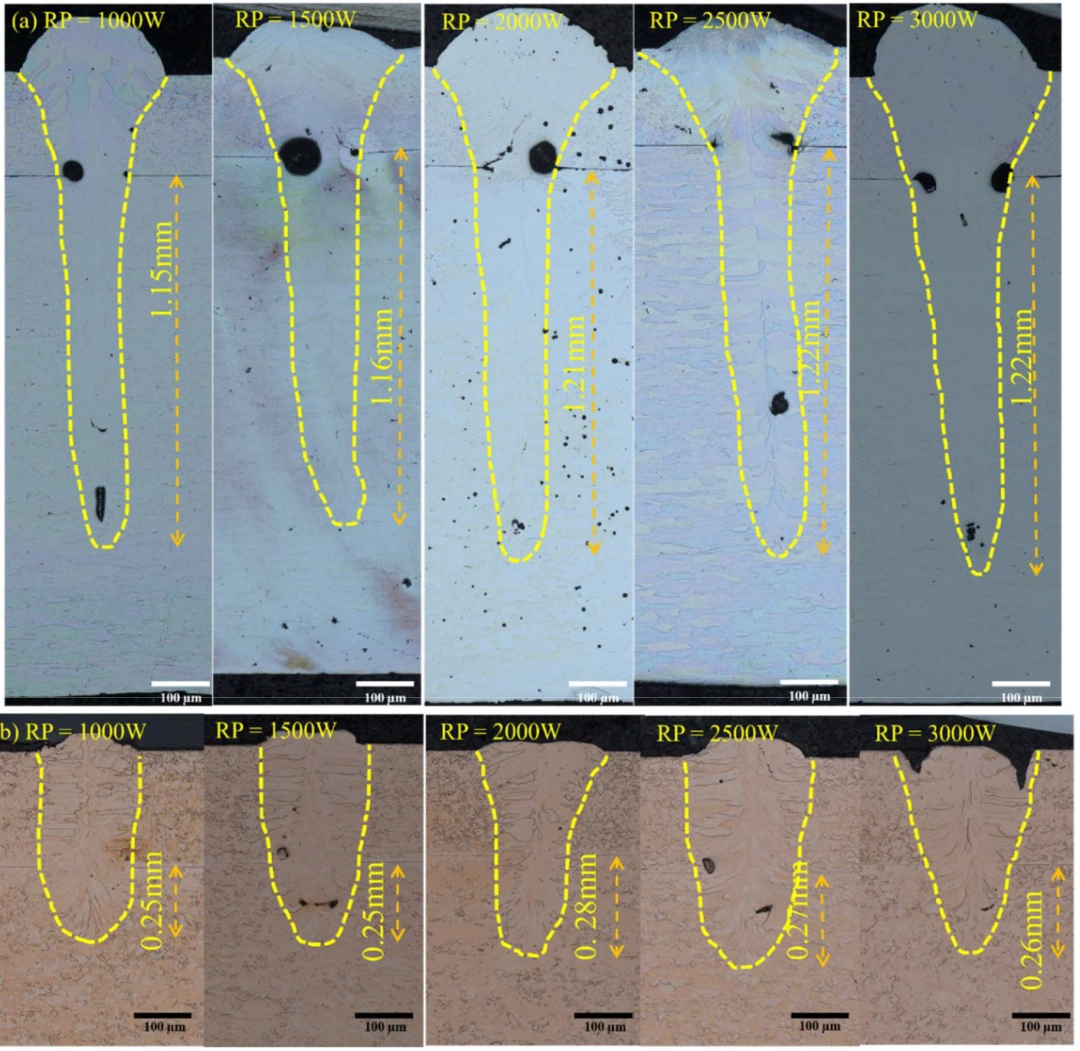
For Al–Al and Cu–Cu, increasing ring power to 2000 W changes depth little but reduces reinforcement and produces a more stable pool. The broad preheat and postheat resemble controlled beam oscillation by smoothing heat input.
For dissimilar joints the effect depends on stacking order:
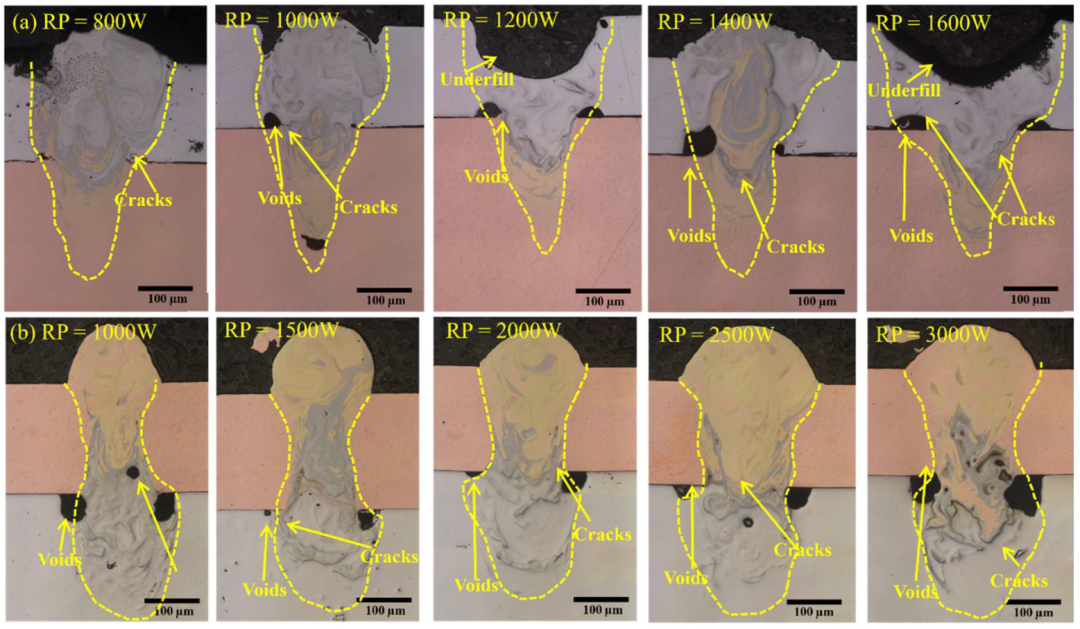
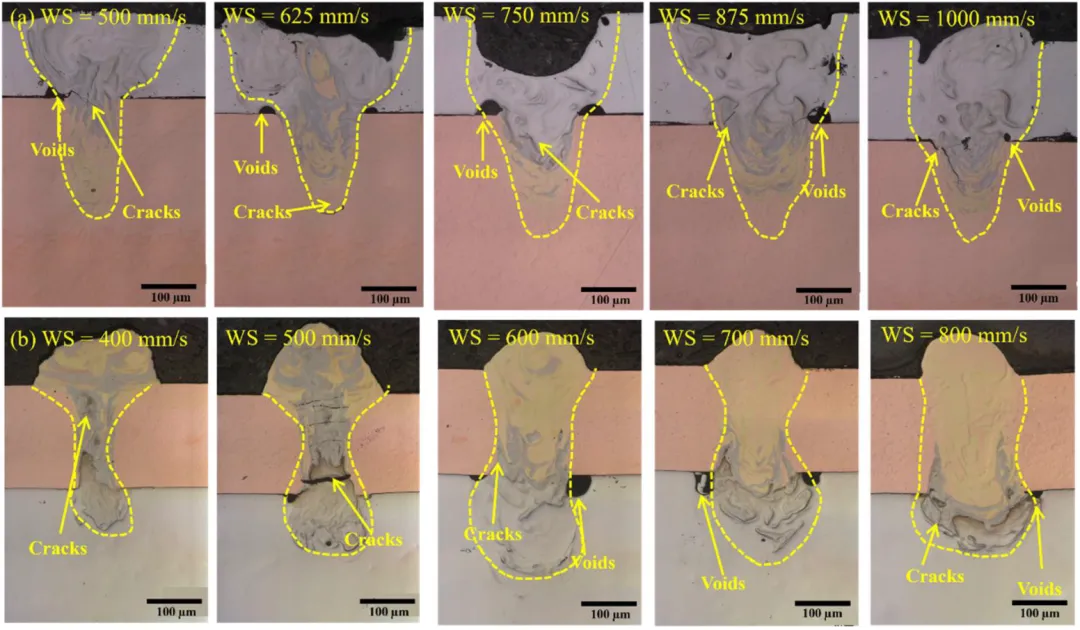
- Al–Cu: raising ring power from 900 to 1600 W increases root voids and cracks; excessive broad heating promotes IMC growth.
- Cu–Al: raising ring power to 2000 W lowers bead height and suppresses upward aluminum flow, improving stability.
Travel speed
Speed controls line energy and cooling rate and is especially important when IMC growth is the limiting factor.
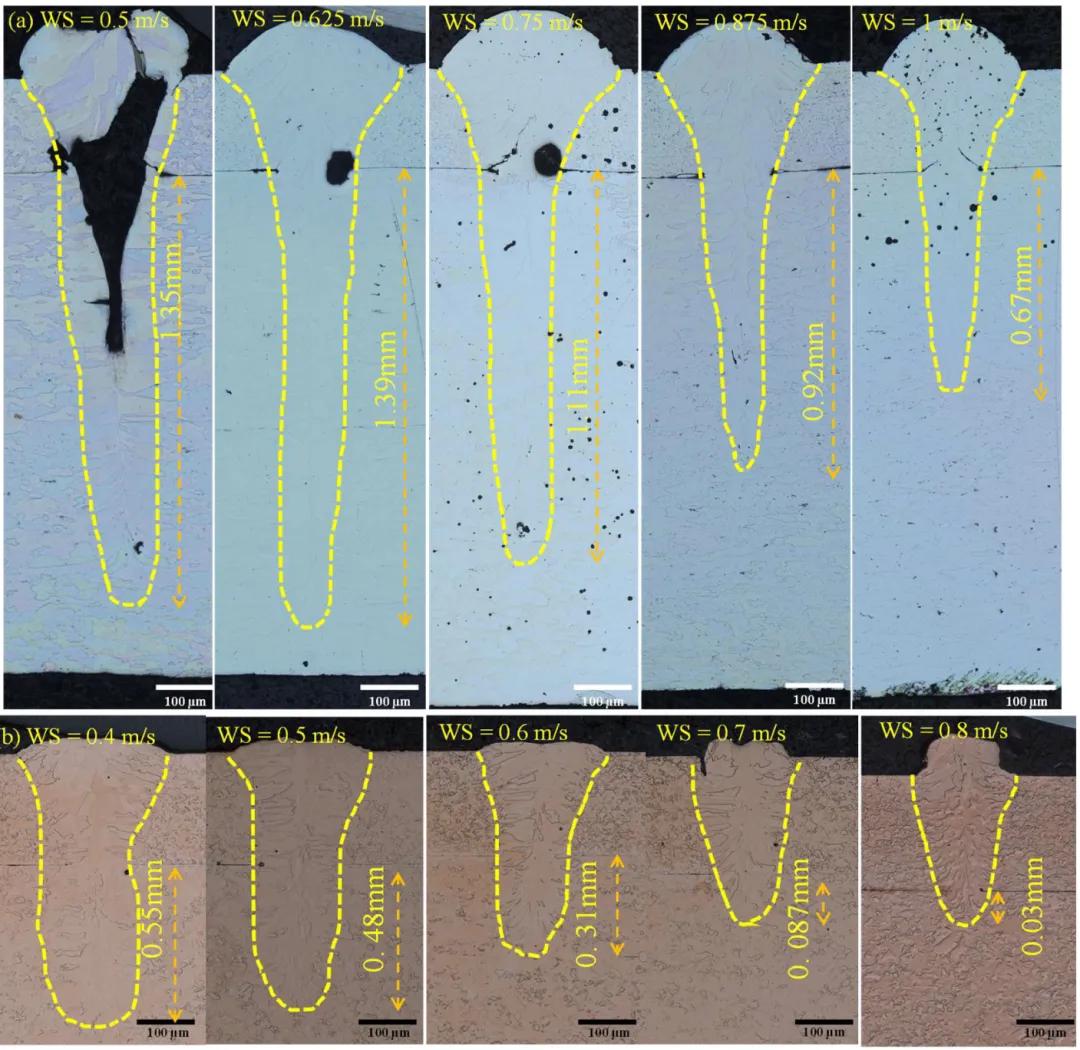
For Al–Al and Cu–Cu, increasing speed from 0.5 to 1 m/s reduces depth but does not greatly change joint strength in the studied range.
For Al–Cu, lower speed produces greater heat input, while a faster 1 m/s condition limits mixing and lowers crack risk through rapid solidification. For Cu–Al, approximately 0.8 m/s gives fast cooling that suppresses IMCs and cracking while retaining useful fusion.
Intermetallic compounds
At 1400 W core power, the bottom of an Al–Cu weld contains Al₂Cu and Al₄Cu₉ with relatively little cracking. Faster cooling can reduce the time available for growth, but IMCs still form if total heat and mixing are excessive.
In Cu–Al joints, CuAl₂ and CuAl appear mainly near the bottom under lower core power. A speed near 0.8 m/s controls both IMC growth and cracking more effectively.
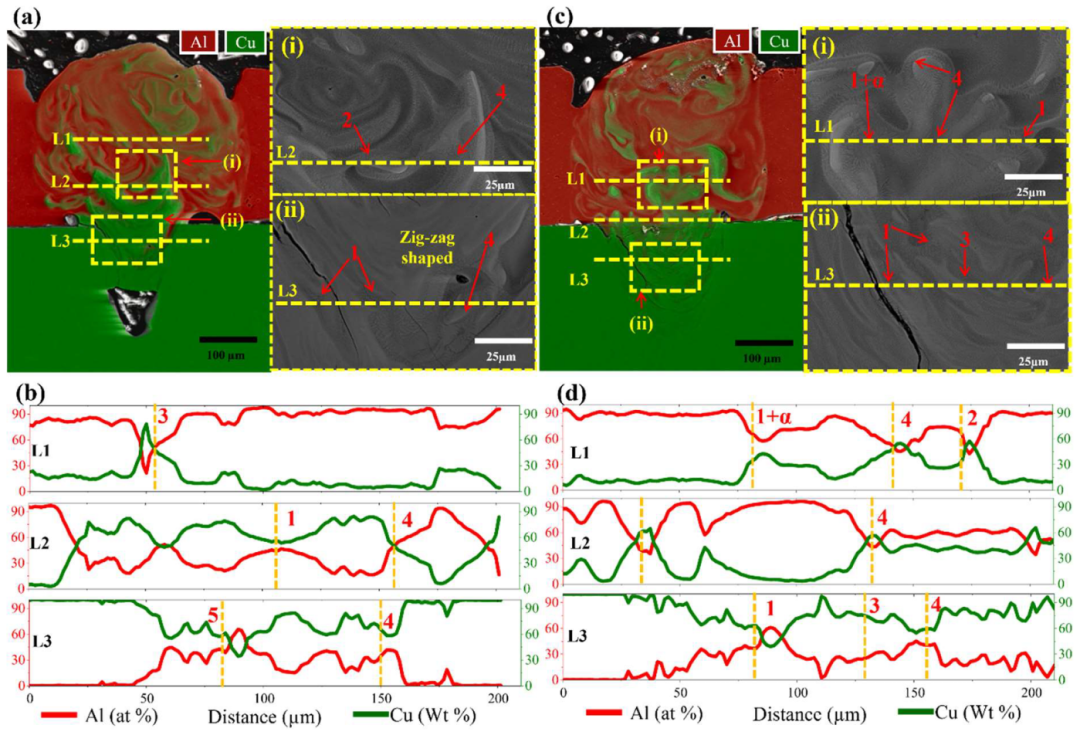
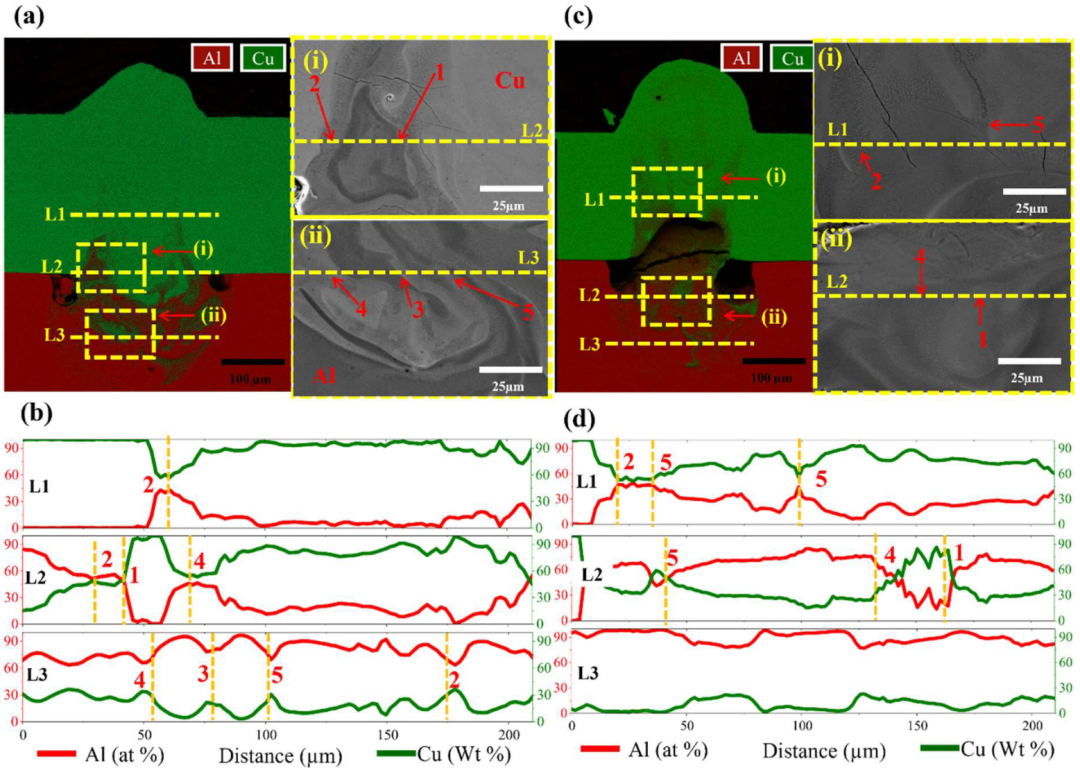
The paper identifies IMC phases and distributions but does not quantify layer thickness or map thickness directly to performance. Production development should add that measurement and correlate it with strength, resistance, fatigue, and aging.
Electrical and thermal performance
Mechanical strength alone is not sufficient. A battery connection carries high current and must remain low-resistance and cool.
Cu–Cu joint
Al–Al joint
Cu–Cu at 150 A
Al–Al at 150 A
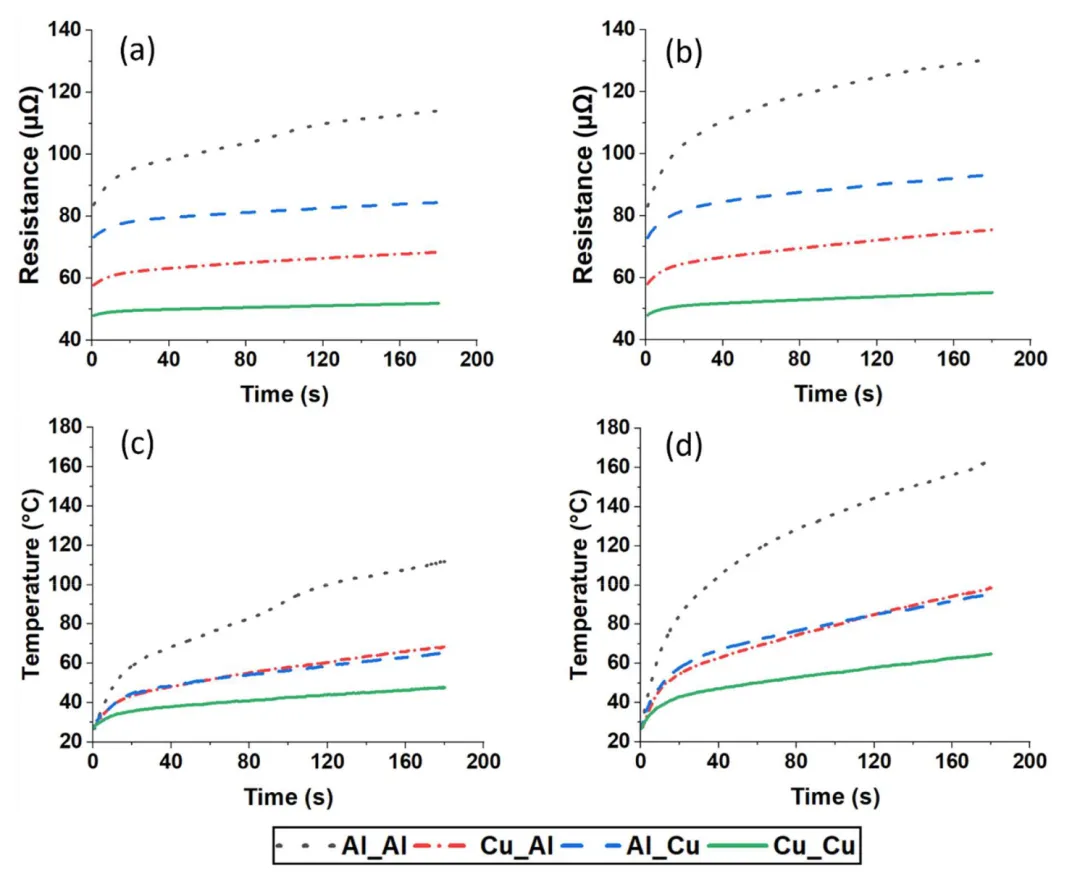
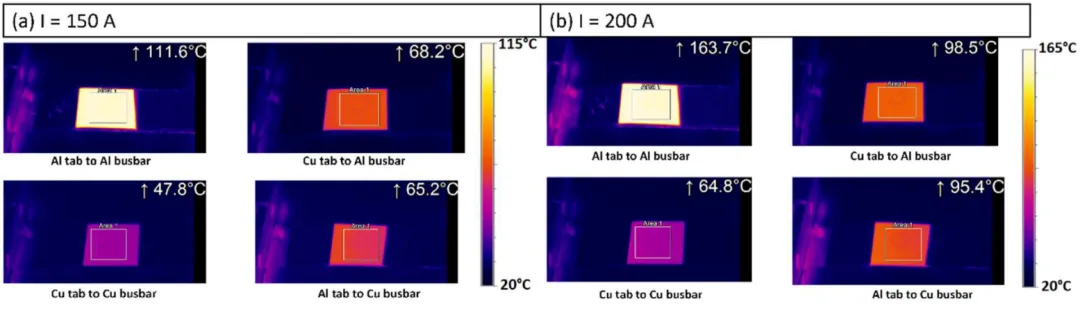
Cu–Cu has the lowest measured resistance, 0.05 mΩ, while Al–Al reaches 0.15 mΩ. At 150 A, Cu–Cu stabilizes near 47.8 °C, whereas Al–Al reaches 111.6 °C. Al–Cu and Cu–Al occupy intermediate ranges of roughly 65–96 °C.
Copper gives the best electrical result, but aluminum remains attractive because it is lighter and less expensive. Material choice must therefore be based on system-level mass, cost, thermal design, and safety rather than one joint metric.
Engineering questions
- Quantify IMC thickness. Phase identification alone cannot predict brittleness or electrical behavior.
- Include production variation. Alloy chemistry, surface condition, plating, and dimensional tolerance all shift absorptance and pool dynamics.
- Test modern fast-charging loads. The paper’s 150 and 200 A tests are below some present high-voltage, high-rate charging demands.
- Validate lifetime. Vibration and thermal cycling repeatedly load the weld; fatigue and accelerated-aging tests are required.
The broader question is not only whether a joint can be made, but whether it remains electrically and mechanically stable throughout the battery’s service life.
Reference
Nikhil Kumar et al., “Dual-Mode Laser Beam Welding of Similar and Dissimilar Material Tab-to-Busbar for Electric Vehicle Battery Pack”, Journal of Advanced Joining Processes, 10 (2024), 100250. DOI: 10.1016/j.jajp.2024.100250.
The original Chinese edition was published by “Laser Insights” on March 3, 2025. This page preserves the technical data, figures, and reference while reorganizing the material for long-form reading.